剑指 offer 52. 两个链表的第一个公共节点
剑指 Offer 52. 两个链表的第一个公共节点
输入两个链表,找出它们的第一个公共节点。
如下面的两个链表:
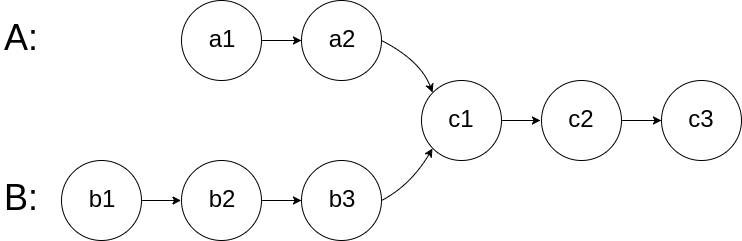
在节点 c1 开始相交。
示例 1:
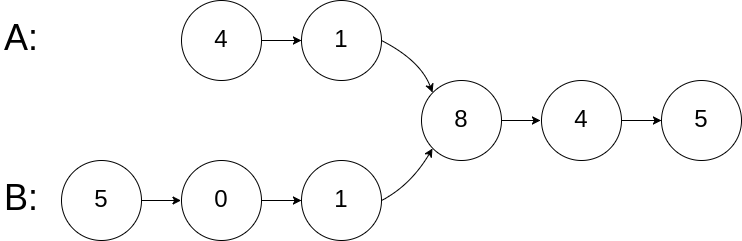
输入:intersectVal = 8, listA = [4,1,8,4,5], listB = [5,0,1,8,4,5], skipA = 2, skipB = 3
输出:Reference of the node with value = 8
输入解释:相交节点的值为 8 (注意,如果两个列表相交则不能为 0)。从各自的表头开始算起,链表 A 为 [4,1,8,4,5],链表 B 为 [5,0,1,8,4,5]。在 A 中,相交节点前有 2 个节点;在 B 中,相交节点前有 3 个节点。
示例 2:
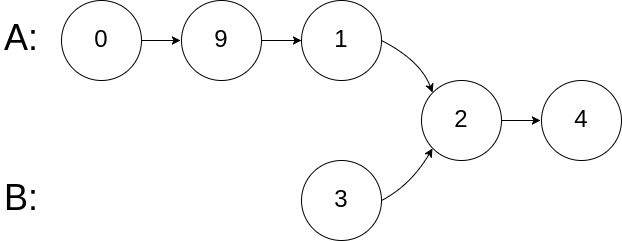
输入:intersectVal = 2, listA = [0,9,1,2,4], listB = [3,2,4], skipA = 3, skipB = 1
输出:Reference of the node with value = 2
输入解释:相交节点的值为 2 (注意,如果两个列表相交则不能为 0)。从各自的表头开始算起,链表 A 为 [0,9,1,2,4],链表 B 为 [3,2,4]。在 A 中,相交节点前有 3 个节点;在 B 中,相交节点前有 1 个节点。
示例 3:
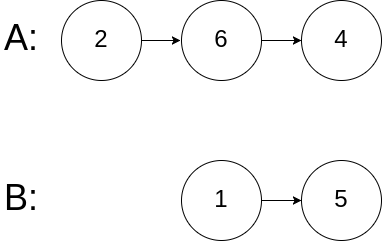
输入:intersectVal = 0, listA = [2,6,4], listB = [1,5], skipA = 3, skipB = 2
输出:null
输入解释:从各自的表头开始算起,链表 A 为 [2,6,4],链表 B 为 [1,5]。由于这两个链表不相交,所以 intersectVal 必须为 0,而 skipA 和 skipB 可以是任意值。
解释:这两个链表不相交,因此返回 null。
注意:
- 如果两个链表没有交点,返回 null.
- 在返回结果后,两个链表仍须保持原有的结构。
- 可假定整个链表结构中没有循环。
- 程序尽量满足 O(n) 时间复杂度,且仅用 O(1) 内存。
- 本题与主站 160 题相同:https://leetcode-cn.com/problems/intersection-of-two-linked-lists/
来源:力扣(LeetCode) 链接:https://leetcode-cn.com/problems/liang-ge-lian-biao-de-di-yi-ge-gong-gong-jie-dian-lcof 著作权归领扣网络所有。商业转载请联系官方授权,非商业转载请注明出处。
Solution 1
可以将A,B链表的长度分别假定为a+n,b+n其中n为共享部分的长度。
由上述假设可知,当A,B同时分别各走出a+b+n时,AB相同且为共享部分的第一个节点。
在算法实现上,不直接求a,b,n的值。选择每次迭代AB同时走出一步,并比较是否相同。
如果第一次走到末尾,换到对方头节点。如果第二次走到末尾,说明无重复。
/**
 * Definition for singly-linked list.
 * public class ListNode {
 *     int val;
 *     ListNode next;
 *     ListNode(int x) {
 *         val = x;
 *         next = null;
 *     }
 * }
 */
public class Solution {
    public ListNode getIntersectionNode(ListNode headA, ListNode headB) {
        ListNode A = headA;
        ListNode B = headB;
        boolean A2B = false, B2A = false;
        while (A != null && B != null) {
            if (A == B)
                return A;
            A = A.next;
            if (A == null && !A2B) {
                A = headB;
                A2B = true;
            }
            B = B.next;
            if (B == null && !B2A) {
                B = headA;
                B2A = true;
            }
        }
        return null;
    }
}
Solution 2
cpp
/**
 * Definition for singly-linked list.
 * struct ListNode {
 *     int val;
 *     ListNode *next;
 *     ListNode(int x) : val(x), next(NULL) {}
 * };
 */
class Solution
{
public:
    ListNode *getIntersectionNode(ListNode *headA, ListNode *headB)
    {
        ListNode *a = headA, *b = headB;
        bool a2b = true, b2a = true;
        while (a != NULL && b != NULL)
        {
            if (a == b)
            {
                return a;
            }
            a = a->next;
            b = b->next;
            if (a == NULL && a2b)
            {
                a2b = false;
                a = headB;
            }
            if (b == NULL && b2a)
            {
                b2a = false;
                b = headA;
            }
        }
        return NULL;
    }
};